


Connectivity
Wi-Fi 7 reaches Africa, barely
Global Wi-Fi adoption is gathering pace, but Africa’s wireless networks remain rooted in older standards.

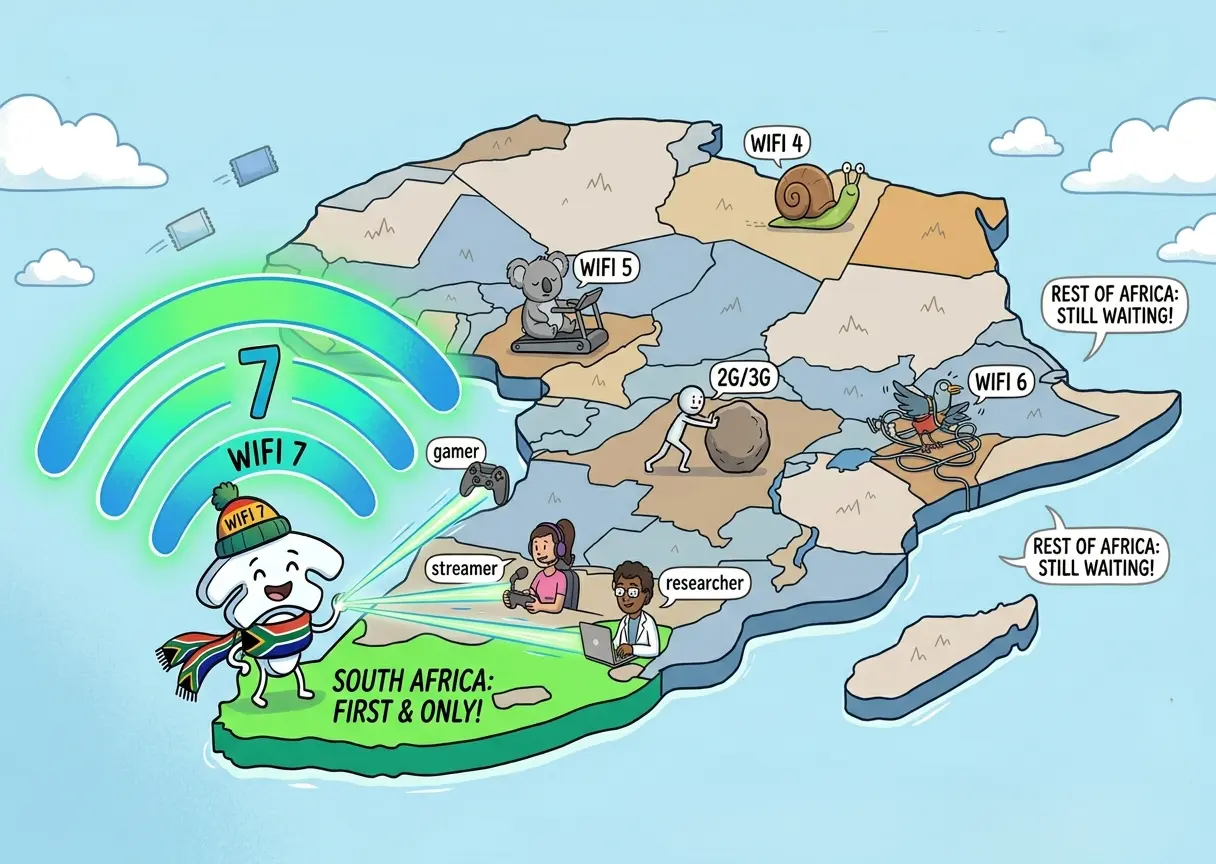
Only one African country recorded measurable use of the 6GHz spectrum band used by Wi-Fi 6E and Wi-Fi 7 in Ookla’s latest global study. That country was South Africa, where it accounted for just 0.2% of Wi-Fi connections.
The figures come from Ookla’s Global State of Wi-Fi 2026 report, which analysed Wi-Fi usage data gathered through its Speedtest platform. While North America recorded 13.8% of Wi-Fi traffic on the 6GHz band during the first quarter of 2026, Africa rounded down to effectively zero. South Africa was the continent’s only market to show measurable usage.
The finding is striking because South Africa has already done the regulatory work needed to support the latest Wi-Fi standards.
The Independent Communications Authority of South Africa (Icasa) opened the lower 6GHz band for licence-exempt use in 2023, making spectrum available for Wi-Fi 6E and Wi-Fi 7 devices. Earlier this year, the regulator confirmed that the band would remain available for shared use rather than being assigned exclusively to mobile operators.
South Africa therefore finds itself in an unusual position. The spectrum needed for the latest generation of Wi-Fi is available, yet uptake remains tiny.
To understand why, it helps to look at the global picture.
Wi-Fi adoption tends to move more slowly than mobile technology. Consumers replace smartphones every few years. Routers often remain in service for far longer. Businesses may upgrade laptops regularly while leaving networking equipment untouched for a decade. The result is that several generations of Wi-Fi typically coexist.
That pattern is visible throughout the world, although some regions are moving faster than others.
According to Ookla, Wi-Fi 5 remains the most widely used standard globally, accounting for 44.5% of measured connections. Wi-Fi 6 follows at 27.9%, while Wi-Fi 4 still represents 25.8%. Wi-Fi 7 has reached 1.8%, a modest figure that nevertheless reflects rapid early growth.
The strongest momentum is coming from Asia.
Singapore has emerged as the global leader in Wi-Fi 7 adoption, with more than a quarter of measured connections using the standard. The country has benefited from extensive fibre deployment, widespread availability of compatible hardware and broadband providers that increasingly bundle advanced routers with high-speed connectivity packages.

Several other Asian markets are following a similar path. Consumers upgrading smartphones, laptops and home networking equipment are creating a steady pipeline of devices capable of using the latest standards.
North America has also embraced the transition.
The region’s 13.8% share of 6GHz traffic reflects a combination of regulatory support, strong broadband infrastructure and aggressive deployment of compatible equipment by internet service providers. For many consumers, a new router arrives as part of a broadband contract rather than as a separate purchase decision.
Europe presents a more mixed picture. Adoption rates vary between countries, reflecting different regulatory approaches to 6GHz spectrum as well as differences in broadband markets and consumer spending patterns.
Against that backdrop, Africa stands apart.
According to Ookla, Wi-Fi 4, introduced in 2009, still accounts for 48.8% of Wi-Fi samples across the continent. Wi-Fi 5 represents 34.4%, while Wi-Fi 6 reaches 16.8%. Wi-Fi 7 appears in only 0.1% of sampled connections.
Those figures suggest that much of Africa remains focused on transitions that other regions completed several years ago.
That should not come as a surprise.
For many African countries, extending internet access remains a higher priority than upgrading wireless equipment within homes and businesses. Fibre networks continue to expand, fixed-wireless services are reaching new communities and mobile broadband remains the primary form of internet access for millions of people.
In that context, a functioning router often remains in service for as long as possible.
South Africa’s position within the continent reflects both its strengths and its constraints.
The country has one of Africa’s most developed broadband markets. Fibre coverage continues to expand, competition among internet service providers remains intense and consumers have access to a wide range of networking equipment. Wi-Fi 6E and Wi-Fi 7 products are readily available through major retailers and service providers.
Availability, however, is only one part of the equation.
Many existing devices cannot use the 6GHz band. Wi-Fi 6 hardware, despite its name, lacks access to the spectrum. Consumers require Wi-Fi 6E or Wi-Fi 7 equipment on both the network and device side before they experience the benefits.
That creates a gradual upgrade cycle rather than a sudden shift.
A household may replace a smartphone this year, a laptop next year and a router several years later. Businesses often follow a similar pattern, refreshing equipment according to budgets rather than technology roadmaps. New standards spread through the market incrementally.
The growth of AI-powered services may accelerate that process.
Cloud-based AI tools, image generators, virtual assistants and collaborative platforms place increasing demands on network performance. While broadband speed receives most of the attention in marketing campaigns, wireless connectivity inside homes and offices increasingly influences the user experience.
The 6GHz band was introduced partly to address those pressures.
It provides substantially more spectrum than the traditional 2.4GHz and 5GHz bands, creating additional capacity for high-density environments. That capacity becomes increasingly valuable as homes accumulate connected televisions, gaming consoles, security systems, smart appliances and mobile devices.
For South Africa, the report offers a snapshot of a market at an early stage of the transition to next-generation Wi-Fi.
For Africa, it highlights the scale of the journey still ahead.
The continent’s internet story has traditionally focused on access: who is connected, where connectivity is available and how much it costs. Ookla’s latest data points to a different question. As broadband becomes more widely available, the quality of the wireless networks carrying that connectivity within homes, schools and businesses will play an increasingly important role in determining how people experience the internet.